
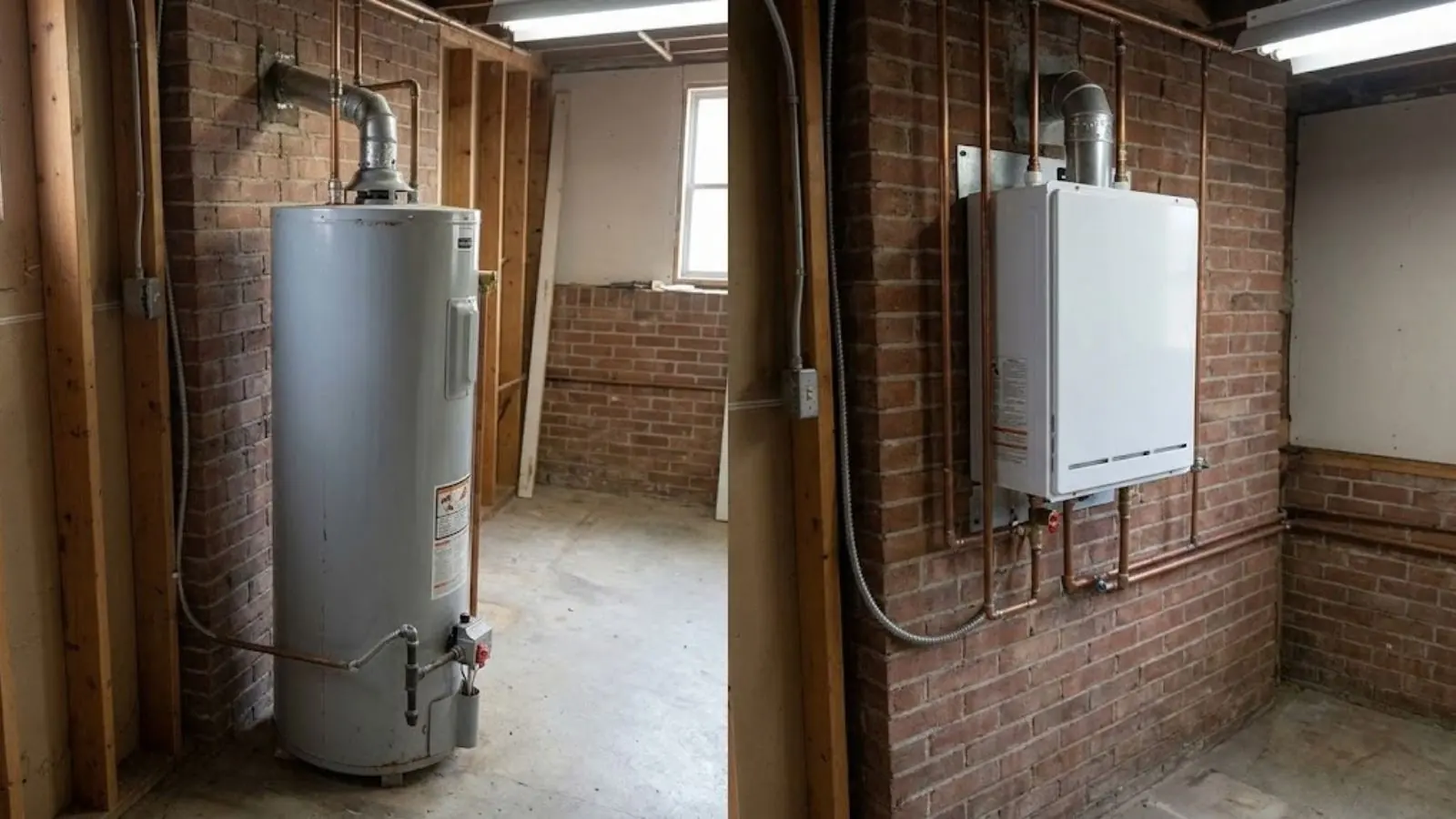
How a Condensing Tankless Unit Works
A standard tankless heater burns gas to heat water as it passes through a heat exchanger. A condensing model adds a second heat exchanger that pulls heat from the exhaust gases before they leave. That extra step cools the exhaust enough that water vapor condenses into liquid.
The result is a more efficient unit that wastes less heat up the vent. The trade-off is that the condensate is acidic and has to be drained, and the exhaust can use plastic venting instead of metal.
Tank, Standard Tankless and Condensing Tankless Compared
The condensate drain is the item that surprises most homeowners.
| Feature | Tank heater | Standard tankless | Condensing tankless |
|---|---|---|---|
| Hot water supply | Limited by tank size | Continuous on demand | Continuous on demand |
| Standby heat loss | Yes | No | No |
| Exhaust venting | Metal flue or power vent | Stainless steel | Often plastic |
| Condensate drain | Not needed | Not needed | Required |
| Floor space | Large | Wall mounted | Wall mounted |
What Changes in the House
A tankless unit hangs on a wall, so the footprint in the basement shrinks. The gas line often needs to be larger than a tank would use, because the burner draws more gas at once. The venting must follow the manufacturer's rules for length, slope and termination.
A condensate line must run to a floor drain, a condensate pump or another approved drain. In a Shrewsbury basement with an older floor drain, the location of that drain can shape where the unit goes.
Sizing for a Real Household
Tankless sizing is about flow rate and temperature rise, not tank gallons. Add up the fixtures you might run at once, such as a shower, a dishwasher and a laundry load, and compare that to the unit's rated flow. Incoming water temperature matters too, because winter water is colder and the heater must work harder to raise it.
An undersized unit gives you lukewarm water when two fixtures run. A properly sized one handles the busiest morning without a complaint.
What Drives the Cost of a Tankless Install
The unit is only part of the price. Gas line upsizing, new venting, a condensate drain, an electrical outlet for the control board and any needed wall repair all add to the total. A house that already has a good gas supply and a vent path costs far less to convert than one that needs everything new.
That is why we explain the clear price before work starts and walk through each line item. Ask any installer to break the quote into unit, venting, gas, drain and labor, so you can compare like with like.
Questions Worth Asking Any Installer
Ask which unit sizes are being considered and why, and how the flow rate was worked out. Ask how the exhaust will be vented and where the condensate will drain. Ask whether the existing gas meter and line can handle the load, and what service the unit needs each year.
A good answer is specific to your house. A vague answer usually means the installer has not looked at the basement yet.
Planning a Tankless Swap in a Shrewsbury Home
Shrewsbury grew fast as a streetcar suburb, with its population roughly doubling between 1915 and 1940, so many houses have older basements and original floor drains. A condensate line needs a drain it can reach, so check where yours sits before you choose a wall.
Ask the Shrewsbury building department whether a permit is needed for a gas appliance change. Local requirements can differ from one job to the next, and the department can answer for your address.
Maintenance and Flushing
Tankless units need periodic flushing to clear mineral scale from the heat exchanger. The interval depends on your water and how hard the unit works. Well-fed town water carries minerals, so ask the Shrewsbury water department for its latest report and plan your flush schedule around it.
Condensing units also need the condensate trap and neutralizer checked, since the acidic liquid can damage a drain if it is not treated. Our tankless water heater page covers install, repair and flush work.
Weighing a Tank Against Tankless?
Call and we will walk through venting, gas and drain needs for your home before any commitment.
Nearby Towns and Next Steps
Homeowners in Grafton and Westborough ask about the same upgrade. If you are replacing a tank that has failed, water heater replacement compares the options in one place.
Condensing Tankless Questions
It makes the most sense for a household with steady hot water use and a gas supply that can handle the load. The efficiency gain is real, but so are the extra installation requirements.
Yes. The condensate must go to an approved drain, and it is usually acidic, so many installs add a neutralizer.
Rarely. Venting and gas sizing usually change, and the manufacturer's instructions decide what is allowed.
Follow the manufacturer's guidance, and adjust for how mineral-rich your water is.
Often yes, as long as there is wall space, a path for venting and a drain for the condensate. A site visit confirms it.